

To understand what your rights and obligations are, it is important to know where those rights and obligations come from. From coast-to-coast, Canada is an extremely diverse country, and the sources of law in Canada are at no exception. While the law varies from province to province, there are some overarching areas of law that are the same across the entire country. There are different levels of superiority between sources of law that are important to recognize when conflicts arise. The following article will be used to provide a summary of the landscape of sources of law, surrounding family-law in Canada.
The Constitution and the Charter
The foundation of Canada’s laws, and the corresponding rights and obligations placed upon its citizens, can generally be found to come from Canada’s Constitution Act, 1982. This piece of legislation was brought into force in 1982 and recognized that Canada had full sovereignty over its own constitution and affairs. The Constitution Act, 1982 incorporated several important elements, including the previous British North America Act, 1867 (with some amendments) that formally created Canada as a nation and the Canadian Charter of Rights and Freedoms that provided a bill of rights for all Canadian citizens as well as other individuals in Canada.
While the Constitution and the Charter are extremely important as foundational pieces of the laws of Canada, it is rare that they touch on an average individual’s everyday life. Instead, they generally impact the “behind-the-scenes” workings of other aspects of our legal system. An example of this is the “division of powers” provisions which partition the areas of law that each level of government is allowed to legislate on: you may have read that education is an area of provincial jurisdiction while the criminal law is an area of federal jurisdiction. Another example is the limits placed on police officers in their treatment of alleged criminals, which is highly circumscribed by the rights provided by the Charter.
The important takeaway from the impact of the Constitution and the Charter is that they represent the supreme laws of Canada, and that no laws made from any other sources of law may infringe on those core rights and obligations set out within them.
Jurisdiction and the Divorce Act
Jurisdiction over “divorce” is granted to the federal government via the Constitution Act of Canada, so parties that are married are (largely) governed by the federal Divorce Act upon separation. The Divorce Act specifies the relevant considerations to be made following breakdown of a marital relationship regarding things like decision-making authority and parenting time with children, child support, and spousal support.
By contrast, it is well-recognized that many couples are either not yet married or choose not to get married. For those individuals, provincial jurisdiction applies, and each province has specialized legislation that, while mostly uniform amongst provinces, can have unique elements. In Saskatchewan, legislation governing non-married couples that have children together or in which spousal support may apply include The Children’s Law Act, 2020 and The Family Maintenance Act, 1997. These pieces of legislation recognize rights and obligations between parties who are parents to a child (without necessary defining the relationship as “common-law”) as well as parties who are living together.
To further elaborate, there are also important aspects following the breakdown of a relationship that are governed only by federal or provincial legislation, regardless of whether the parties were married or not. For example, the division of family property following the breakdown of a relationship is governed by provincial legislation. In Saskatchewan, this is through The Family Property Act. Additionally, there will always be exceptions to these general rules.

Divorce in Canada
You can get divorced in Canada even if you married your spouse in another country. Divorces in Canadian courts are recognized in the majority of countries around the world, though you may want to confirm with any specific country that you are concerned about.
Under most circumstances, you are required to provide an original marriage certificate to the court in order to proceed with the divorce process. If it is not in English or French, it may need to be translated.
Marriage v. Common-Law relationship
While there is a difference between the legal definitions of being married and being in a “common-law relationship”, in practice the rights and obligations placed upon people in these circumstances are often quite similar. The difference in legal definitions comes largely from the source of jurisdiction. In terms of the rights and obligations of a parent to a child in a relationship or in a “fling”, there is generally little difference once the relationship has broken down. While the legislation that governs the breakdown of the relationship may differ (i.e., the federal Divorce Act for married couples versus provincial legislation for non-married couples), the decisions regarding decision-making authority and parenting time and the payment of child support are generally the same.
This means that either parent can generally apply to court to try to get decision-making authority or parenting time of the child, or for an order for child support. However, in the case of children with a “fling”, the court may need to look at evidence that points to whether the party is a parent to the child – if the parties were living together at the time of conception, or if the party is named as a parent on the birth certificate, there is a presumption that the party is a parent to the child. If these circumstances aren’t present, however, and the party denies being parent to the child, something further may be required. This can include, for example, a DNA test. In Saskatchewan, a court can’t force a person to take a DNA test. But, if there are circumstances that indicate that a person may be a parent to a child and the person refuses to do so, the court can make an inference against that person and find that they are the parent of the child.
Common law rights to property
If you aren’t married to your partner but you have lived together for some time, your partner can in some circumstances claim rights to property that is solely in your name.
In Saskatchewan, The Family Property Act, which specifies how family property is to be dealt with on the breakdown of a relationship, includes common law partners who have lived together for a period of at least two years. The FPA specifies how certain property is to be distributed, and expressly indicates that family property can be held by “one or both” spouses. So, even if the property is solely in your name, it can be treated as family property and be included in the overall distribution of property following the breakdown of a relationship.
Saskatchewan’s The Homesteads Act takes a non-owning spouse’s rights one step farther. It specifies that before significant actions can be taken regarding real estate property that is solely in one partner’s name, such as selling the family home, the consent of the non-owning spouse must be given and that consent must be given in front of a judge, justice of the peace, lawyer, or notary.
Spousal Support
Spousal support is often a highly variable calculation with a lot of factors at play. One important factor is the roles that the parties each played during the relationship. While many relationships are moving away from the sole-breadwinner type model, it is still often the case that one party either doesn’t work for childcare or other purposes, or they are only able to maintain lower paying jobs. This can affect a court’s determination with respect to spousal support.
The courts have recognized that one party is often disadvantaged in a relationship to provide support to the other party. If, for example, this is the result of a mutual decision by the parties to provide childcare for any kids, this is often a reason a court will stray towards higher spousal support amounts. If, however, one party is simply lazy, and despite encouragement from the other party to find work and to contribute financially they refuse to do so, this may be a factor to limit spousal support. Because of this, many turns on the evidence of each party regarding what those decisions were and why those decisions were made.
Child support obligations
If you are determined by the court to be the parent of a child, you can be ordered to pay child support whether you consented to the child being born or not. Courts have determined that child support is the right of the child, not the parent of the child, and to require both parents to provide consent to the child being born before ordering child support would often leave that child in poor circumstances.

Calculating child support
Child support is, in most circumstances, fairly easy to determine. The basic framework for child support depends on the parenting situation; if one parent has greater than 60% of the parenting time with the child, then that parent receives child support based only on the other parent’s income. If both parents have less than 60% of the parenting time with the children, then child support is paid to the lower-earning parent based on a set-off calculation taking both parent’s incomes into account. These amounts are often referred to as “base” child support amounts. There are, however, other obligations as well.
Children often have many difference expenses associated with them. “Base” child support is generally seen to provide compensation for things like food, clothes, and transportation. There are also often “special or extraordinary” expenses, also referred to as “section 7” expenses. These are generally expenses that not every child will incur but that the court recognizes should be the joint responsibility of both parents, things like medical, extracurricular, and daycare expenses. “Special or extraordinary” expenses are to be divided between the parties on a proportional basis relative to their incomes.
For example, John makes $50,000 and his co-parent Jane makes $75,000. Each parent’s relative proportion of “special or extraordinary” expenses is calculated as follows:
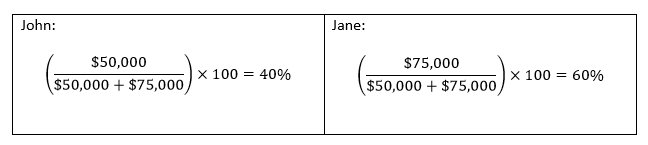
As with many other aspects of family law, there can be several complicating factors in calculating child support. What happens if one party has a really low or a really high income? What happens if one party accuses the other party of deliberately hiding their income, or being underemployed based on their capabilities? What happens if one of the parties owns and is employed by a corporation? What happens if the kids decide to go to post-secondary school away from home? All these situations can change the default child support calculation to a more complicated picture.
Thank you for reading until the end, I expect that this article was helpful in providing you with knowledge about the different sources of law in Canada.